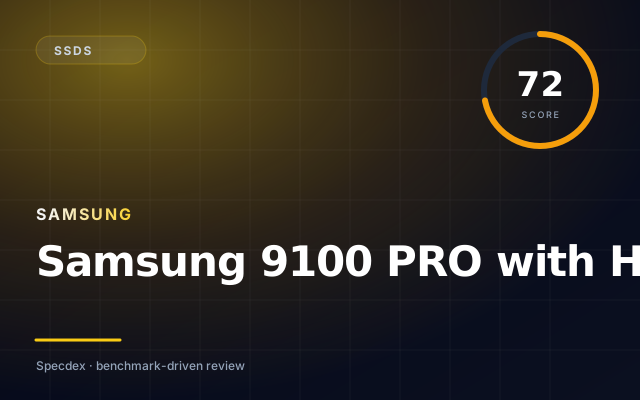
Samsung 9100 PRO with Heatsink 1TB
1TB · PCIe 5.0 NVMe · 14,700 MB/s read · PassMark #55
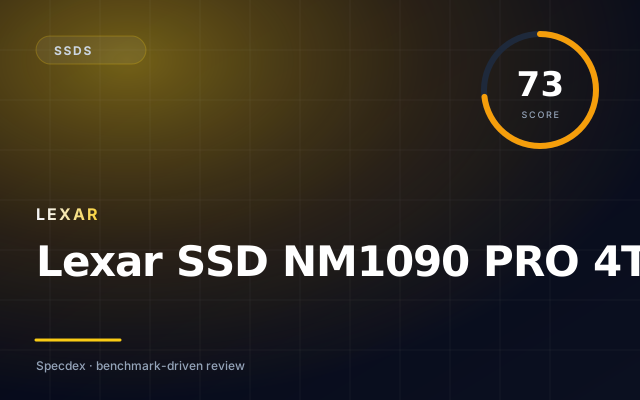
Lexar SSD NM1090 PRO 4TB
4TB · PCIe 5.0 NVMe · 14,000 MB/s read · PassMark #50
Lexar SSD NM1090 PRO 4TB takes it — here’s why.
In our weighted Specdex score, Samsung 9100 PRO with Heatsink 1TB lands at 72 and Lexar SSD NM1090 PRO 4TB at 73. That puts Lexar SSD NM1090 PRO 4TB ahead by 1 points — a narrow margin driven mostly by its strengths in the categories below.
Pick Samsung 9100 PRO with Heatsink 1TB if…
- ✓Capable NVMe drive at PassMark rank #55
- ✓Pro-tier controller and DRAM cache for sustained throughput
- ✓PCIe 5.0 interface for next-gen platforms (AM5, LGA 1851)
Pick Lexar SSD NM1090 PRO 4TB if…
- ✓Strong PCIe 5.0 performance at PassMark rank #50
- ✓Pro-tier controller and DRAM cache for sustained throughput
Winner by scenario
Derived from the sub-score breakdown · not a separate testValue for money
Samsung 9100 PRO with Heatsink 1TBSpecdex score per dollar at MSRP
Samsung 9100 PRO with Heatsink 1TB more score per dollar ($219 vs $400).
Score breakdown
Specs side-by-side
| Spec | Samsung 9100 PRO with Heatsink 1TB | Lexar SSD NM1090 PRO 4TB |
|---|---|---|
| Form factor | M.2 2280 (with heatsink) | M.2 2280 |
| Interface | PCIe 5.0 x4 NVMe 2.0 | PCIe 5.0 x4 NVMe 2.0 |
| Sequential read | 14,700 MB/s | 14,000 MB/s |
| Sequential write | 13,300 MB/s | 12,000 MB/s |
| Random read | 1,850,000 IOPS | 2,100,000 IOPS |
| Random write | 2,600,000 IOPS | 1,700,000 IOPS |
| Controller | Samsung Presto (in-house, 5nm) | Silicon Motion SM2508 (6nm) |
| NAND | Samsung V8 V-NAND 3D TLC (236-layer) | 232-layer Micron B58R 3D TLC |
| DRAM | ▲ yes, LPDDR4X | yes, ~1GB LPDDR4X per TB |
| Endurance | 600 TBW | 2,800 TBW |
| Warranty | 5 years | 5 years |
| PassMark Disk Score | 76,420 | 77,661 |
| PassMark rank | #55 of 100 consumer SSDs | #50 of 100 consumer SSDs |
Samsung 9100 PRO with Heatsink 1TB
- +Capable NVMe drive at PassMark rank #55
- +Pro-tier controller and DRAM cache for sustained throughput
- +PCIe 5.0 interface for next-gen platforms (AM5, LGA 1851)
- −PCIe 5.0 drives run hot — heatsink or motherboard M.2 cooling recommended
- −Newer drives out-perform this generation on sequential + random 4K
Lexar SSD NM1090 PRO 4TB
- +Strong PCIe 5.0 performance at PassMark rank #50
- +Pro-tier controller and DRAM cache for sustained throughput
- −DRAM-less controllers on lower-tier variants may throttle under sustained writes
- −Pricing varies — confirm current retail before purchase
FAQ: Samsung 9100 PRO with Heatsink 1TB vs Lexar SSD NM1090 PRO 4TB
Which is better, Samsung 9100 PRO with Heatsink 1TB or Lexar SSD NM1090 PRO 4TB? +
Lexar SSD NM1090 PRO 4TB scores 73 on our weighted rubric — ahead by 1. Your best pick depends on the sub-scores above.
Is Samsung 9100 PRO with Heatsink 1TB worth the price? +
At $219, Samsung 9100 PRO with Heatsink 1TB delivers a Specdex score of 72 — strongest in passmark_disk.
Is Lexar SSD NM1090 PRO 4TB worth the price? +
At $400, Lexar SSD NM1090 PRO 4TB delivers a Specdex score of 73 — strongest in passmark_disk.
Does Samsung 9100 PRO with Heatsink 1TB or Lexar SSD NM1090 PRO 4TB last longer? +
Based on our long-term update and support ratings, both ship with multi-year support. Battery and reliability scores are visible in the breakdown above.
Which is the better value, Samsung 9100 PRO with Heatsink 1TB or Lexar SSD NM1090 PRO 4TB? +
Samsung 9100 PRO with Heatsink 1TB — more score per dollar ($219 vs $400). Specdex score per dollar at MSRP.